
Few Git topics cause as much debate as rebase vs merge. Both combine work from multiple branches, but they do it in fundamentally different ways. Choosing the wrong one can make history confusing or disrupt teammates.
This post explains the practical difference and when to use each in real workflows.
What Problem Are They Solving?
Git stores commits as a directed acyclic graph (DAG).
When developers work in parallel, branches diverge. At some point, those branches must be brought back together.
That integration happens using either merge or rebase.
What git merge Does
git merge combines branches by creating a new merge commit.
git checkout main
git merge feature-x
Key characteristics
- Preserves commit history exactly as it happened
- Creates a commit with two parents
- Does not rewrite commits
- Safe for shared branches
Why teams use it
- Reliable and predictable
- Excellent audit trail
- Ideal for
main,develop, and release branches
The trade-off is a non-linear history with extra merge commits.
What git rebase Does
git rebase rewrites history by replaying commits on top of another branch.
git checkout feature-x
git rebase main
Key characteristics
- Moves your commits to a new base
- Generates new commit hashes
- Produces a clean, linear history
- Dangerous on shared branches
Why teams use it
- Cleaner
git log - Easier
git bisect - Better commit readability
The risk is history rewriting, which can break collaboration if misused.
The Critical Difference
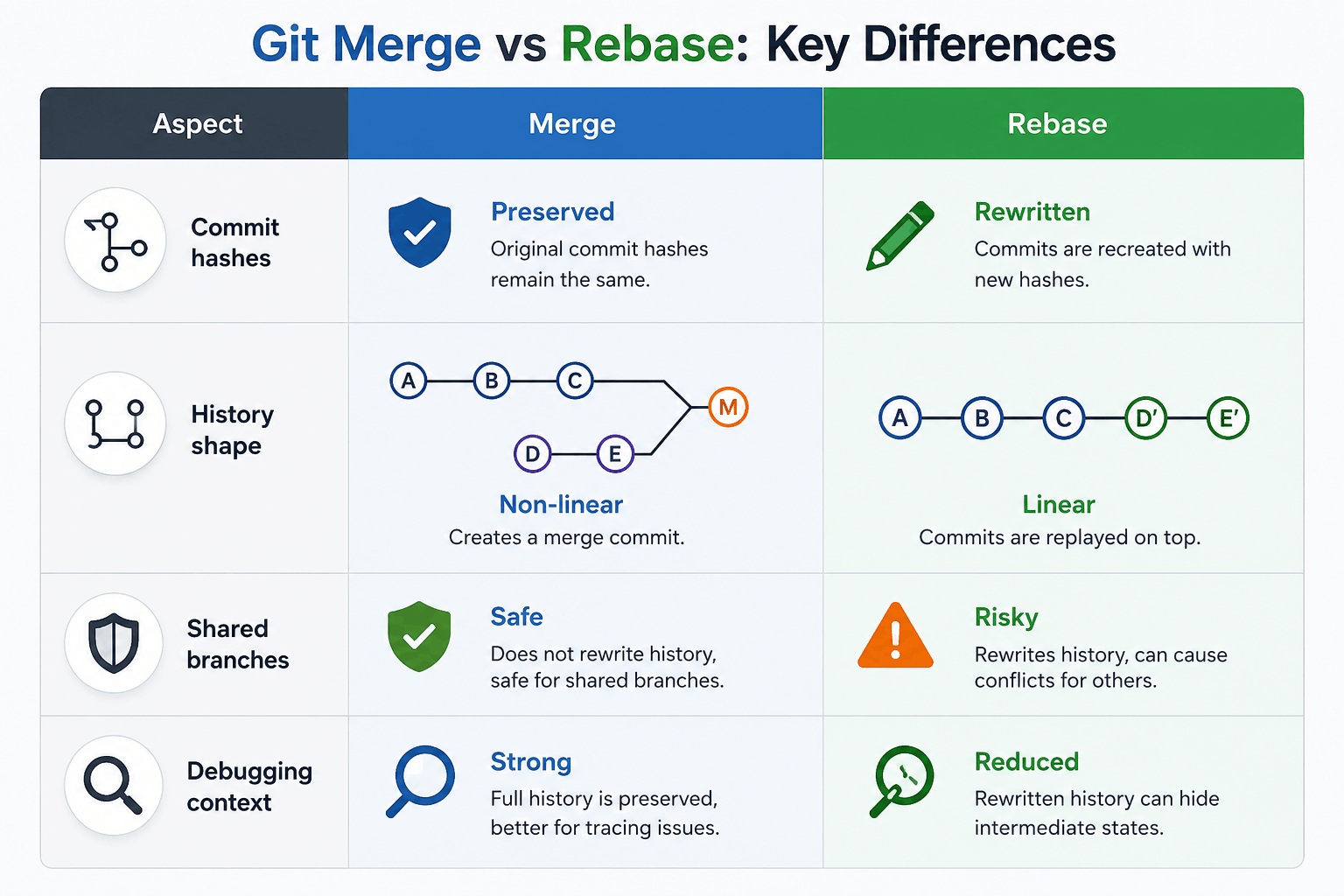
Golden Rule
Never rebase a branch that others have pulled.
Rebase is for local, private branches.
Merge is for shared, long-lived branches.
Real-World Workflow
Most mature teams use both:
- Rebase local feature branches to stay up to date
- Open a pull request
- Merge (or squash-merge) into
main
This keeps local history clean without rewriting shared history.
Final Takeaway
- Merge records history
- Rebase edits history
Use rebase to clean up your own work.
Use merge to safely share your work.
Consistency matters more than preference.
Diagram: Merge vs Rebase (for Blog)
Before:
main:      A---B---C
               \
feature-x:      D---E


After MERGE:
main:      A---B---C-------M
               \         /
feature-x:      D-------E


After REBASE:
main:      A---B---C---D'---E'
feature-x: