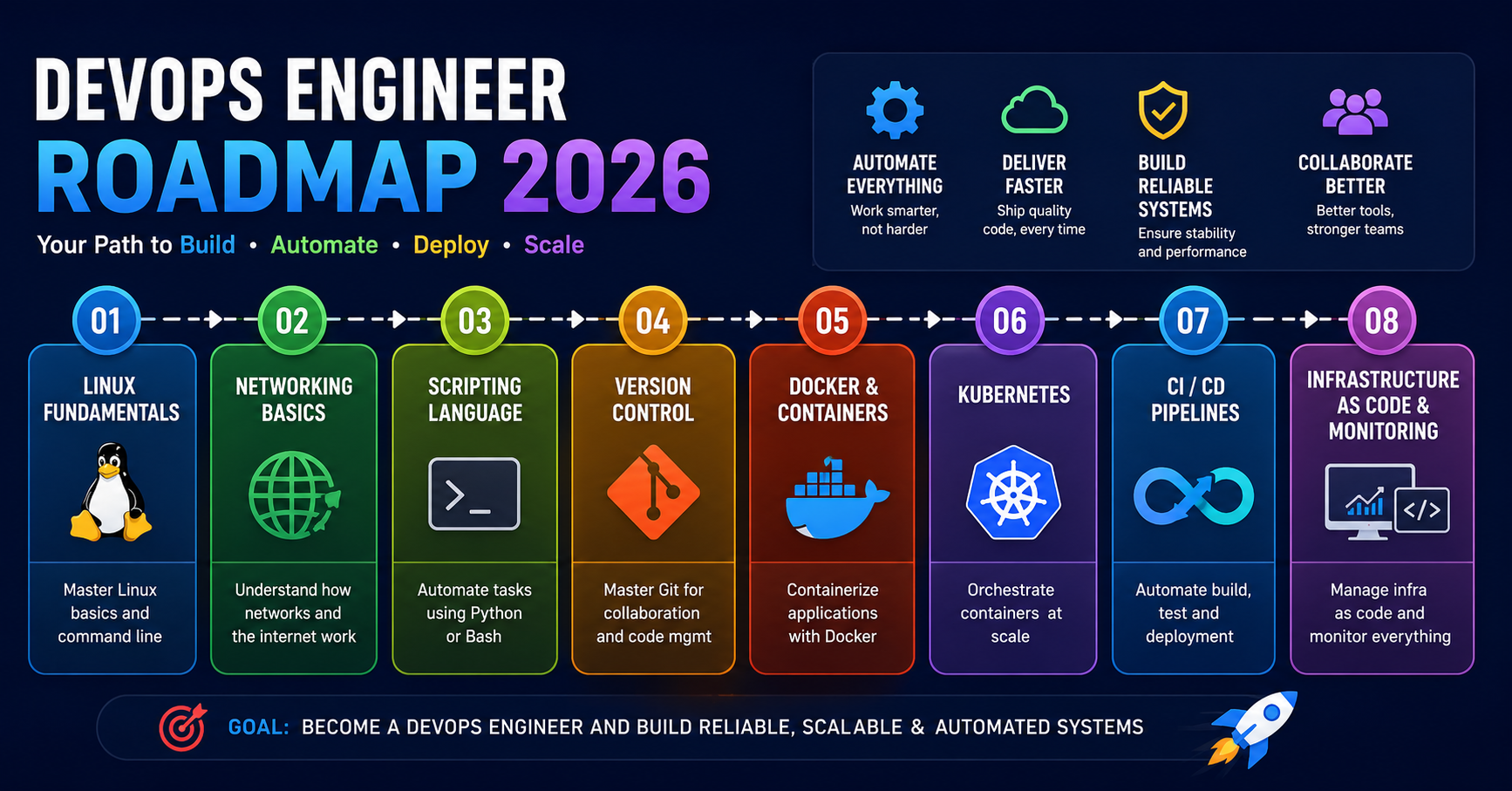
Becoming a DevOps Engineer in 2026?
Let's face it, the term "DevOps" has been vaguely defined and used so much that it's confusing. If you ask five software engineers to define it, you will most likely receive five different definitions.
Here's the good news: DevOps is about closing the time gap between the time it takes to write and deploy software. It's also about lowering costs through automation and increasing availability and ease of deployment for Developers.
In 2026, DevOps is one of the best-paying and fastest-growing career areas in technology.
You will receive an explanation of the steps involved to become a DevOps Engineer — with no fluff — by using this roadmap.
Stage 1: Linux Proficiency
You will never use any cloud service or container that doesn't run on Linux. Therefore, you need to be computer uncomfortable in a console before you ever touch a cloud service or container.
What is it that you will be learning?
- Navigating through an operating system (ls, cd, mv, cp, rm, find)
- Understanding file permissions (chmod, chown, sudo)
- Managing process (ps, top, htop, kill)
- Networking basics (curl, ping, netstat, ss, nmap)
- Writing your own shell scripts to automate your repetitive tasks
- Processing text (grep, awk, sed, cat, tail)
- Package management (apt, yum, dnf)
How will you practice? Practicing with a virtual machine (VM) by installing Ubuntu on a virtual machine (VM) using either VirtualBox or Multipass. After installing, try breaking things and then fixing them again – you will be amazed how much you will learn about Linux by doing so rather than just reading about it.
When should you complete this stage of learning? 4 – 6 weeks of dedicated daily practice
Stage 2: Networking Fundamentals
You do not need to be a network engineer, but understanding how the internet works is critical in any IT role. Most of the difficulties that DevOps face with regard to technology are actually networking based issues.
What will you be learning?
- IP addresses (what are they), subnets (what are they) and CIDR range (what is it)
- DNS (how does your domain get resolved via DNS servers) (What is an A record) (What is a CNAME record) (What does TTL mean)
- The difference between HTTP & HTTPS (what is a TLS certificate) (how does SSL work)
- TCP versus UDP and when to use both.
- Load balancers (what they do and why do they exist).
- Firewalls and security groups (allow/deny rules).
- VPNs and fundamentals of private networking.
Why you need to know: When your application goes down at 2 AM, the first thing that you will ask is if it is a network issue. You need to know how to do a constant diagnosis of network issues.
Stage 3 — Pick Up a Scripting Language
Automation is the heart of DevOps. You need to be able to write scripts that do things automatically so humans don't have to.
Best options in 2026:
Python — the clear winner for DevOps scripting. Every major tool has a Python SDK. Used heavily in automation, monitoring scripts, and infrastructure tooling.
Bash — you'll write Bash every single day. Gluing commands together, writing deployment scripts, CI/CD pipeline steps.
Go — increasingly popular for writing CLI tools and infrastructure tooling. Worth learning once you're comfortable with Python.
Start with Python and Bash. Get comfortable enough to write scripts that read files, make API calls, parse JSON, and automate repetitive tasks.
Stage 4 — Understand Version Control with Git
If you're not already using Git, start today. Everything in DevOps — infrastructure code, application code, configuration — lives in Git.
What to master:
- git clone, commit, push, pull
- Branching strategies — feature branches, GitFlow, trunk-based development
- Pull requests and code review workflows
- Merge conflicts — how to resolve them without panicking
- Git hooks — running scripts before commits or pushes
- Tagging releases
Pro tip: Get comfortable with rebasing. It's one of those things that confuses everyone at first but becomes second nature once you understand it.
Stage 5 — Mastering Docker and Containers
Containers have fundamentally changed how we operate. If by 2026 you are not familiar with Docker, you'll be at a major disadvantage.
Areas of Focus:
- What is a Container, and Why are Containers Better Than Virtual Machines for Most Situations?
- How to Write a Dockerfile (Base Images, Image Layers, Build Context)
- How to Use Docker Commands: Build, Run, Ps and Log, respectively
- How to use Docker-Compose to Run Multi-Container Applications in Local Development
- Image Repositories; e.g., Docker Hub, AWS ECR, GitHub Container Registries
- Container Networking and Volumes
- How to Create Smaller Production Docker Images Using Multi-Stage Builds
How to Create a Real-World Application: Take any web application and containerize it. Then, run the application using Docker-Compose with a database. This exercise will teach you far more than any other course on containers.
Stage 6 — Get Into Kubernetes
Kubernetes is the operating system of the cloud. It's complex, but it's everywhere — and knowing it well is a significant salary multiplier.
What to learn:
- Core concepts — Pods, Deployments, Services, Namespaces
- kubectl — the command line tool for interacting with clusters
- ConfigMaps and Secrets — managing configuration and credentials
- Ingress controllers — routing external traffic into your cluster
- Persistent Volumes — handling stateful applications
- Resource limits and requests — preventing one app from starving others
- Rolling updates and rollbacks
- Helm — the package manager for Kubernetes
Start local: Use minikube or kind to run Kubernetes on your laptop. Deploy a real application. Break it. Fix it.
Then go managed: Spin up a cluster on GKE, EKS, or AKS. Understand what the cloud provider manages for you vs what you're responsible for.
Stage 7 — CI/CD Pipelines
Continuous Integration and Continuous Deployment is what ties everything together. This is where your code goes from a developer's laptop to production automatically.
Tools to know in 2026:
- GitHub Actions — the default choice for most teams now. Easy to start, powerful at scale.
- GitLab CI — excellent if your team uses GitLab. Built-in, no extra setup.
- Jenkins — older but still widely used in enterprise. Worth knowing.
- ArgoCD — GitOps-based continuous delivery for Kubernetes. Becoming the standard.
- Tekton — Kubernetes-native pipelines. Growing in adoption.
What a good pipeline does:
- Runs tests on every pull request
- Builds and pushes a Docker image on merge to main
- Deploys to staging automatically
- Requires manual approval for production
- Sends notifications on success or failure
Build this pipeline yourself. The hands-on experience is irreplaceable.
Stage 8 — Infrastructure as Code
Clicking around in cloud consoles does not scale. Infrastructure as Code (IaC) means your servers, databases, networks — everything — is defined in code and version controlled in Git.
Tools to learn:
- Terraform — the industry standard. Works with every major cloud provider. Learn this first.
- Ansible — configuration management. Great for provisioning servers, installing software, managing configuration at scale.
- Pulumi — IaC using real programming languages (Python, TypeScript, Go). Growing quickly as an alternative to Terraform.
- OpenTofu — the open-source fork of Terraform. Increasingly adopted since HashiCorp changed Terraform's license.
Key concepts:
- Declarative vs imperative infrastructure
- State management — what Terraform state is and why it matters
- Modules — reusable infrastructure components
- Remote state — storing state in S3 or Terraform Cloud
Stage 9 — Cloud Platforms
You need to be comfortable in at least one major cloud platform. In 2026, the big three are still AWS, Azure, and GCP — with AWS holding the largest market share.
Where to start:
AWS — most job postings mention AWS. Start here. Focus on:
- EC2, VPC, Security Groups
- S3 — object storage
- RDS — managed databases
- EKS — managed Kubernetes
- IAM — identity and access management (critical — get this right)
- CloudWatch — logs and monitoring
- Route53 — DNS
Top certifications to have in 2026:
- AWS Certified Solutions Architect — Associate (vastly known)
- Certified Kubernetes Administrator (CKA) — highly regarded
- HashiCorp Terraform Associate — useful for Infrastructure as Code positions
Having certifications does not guarantee employment; however, they assist you with validating knowledge and bypassing automated filters on resumes.
Stage 10 — Monitoring & Observability
How do you know whether or not your app is "working" after it is deployed? You have observed the app's performance through observability.
To help determine if your application is functioning as expected (up and running), consider tracking three aspects during observability. First, Metrics (e.g., CPU Usage, Error Rates). Second, Logs (e.g., What happened and when?). Third, Traces (e.g., Following a request as it moves through multiple services).
Four (4) tools to know: Metrics & Dashboards through Prometheus and Grafana. Logging through Loki. If you work for a larger organization and require performance metrics — use Datadog. And, as an emerging common standard across the above three categories, consider using OpenTelemetry.
Solid monitoring includes a dashboard giving you a high-level view of your systems' health and alerts you only at the time of required attention (not just to wake you up at 3 AM).
What the DevOps Job Market Looks Like in 2026
The market is strong but more selective than it was in 2021-2022. Companies are looking for engineers who can demonstrate real experience, not just certifications.
Roles in high demand:
- Platform Engineer — building internal developer platforms
- Site Reliability Engineer (SRE) — reliability-focused, heavy on software engineering
- Cloud Engineer — infrastructure and cloud architecture
- DevSecOps Engineer — security integrated into DevOps workflows
Remote roles are still widely available, particularly for mid and senior engineers.
Your 12-Month Action Plan
- 1 - 2 Mo: Linux, network basics, Git, Python and Bash scripting
- 3 - 4 Mo: Docker and Docker Compose, build and containerize your own projects
- 5 - 6 Mo: Learn the basics of Kubernetes and deploy live applications on a managed cluster
- 7 - 8 Mo: CI/CD with GitHub Actions — build a complete pipeline, from the ground up
- 9 - 10 Mo: Learn the basics of Terraform, provision real infrastructure on AWS, and be prepared to take the Solutions Architect Associate certification
- 11 - 12 Mo: Monitoring with Prometheus and Grafana, basic security fundamentals, then apply for junior developer positions
Final Thought
The engineers who succeed in DevOps are the ones who build things. Not the ones who watch the most courses or collect the most certifications — the ones who spin up servers, break them, fix them, automate them, and do it all over again.
Start with Linux. Pick one thing. Build something real. Then move to the next thing.
The roadmap is here. The rest is up to you.