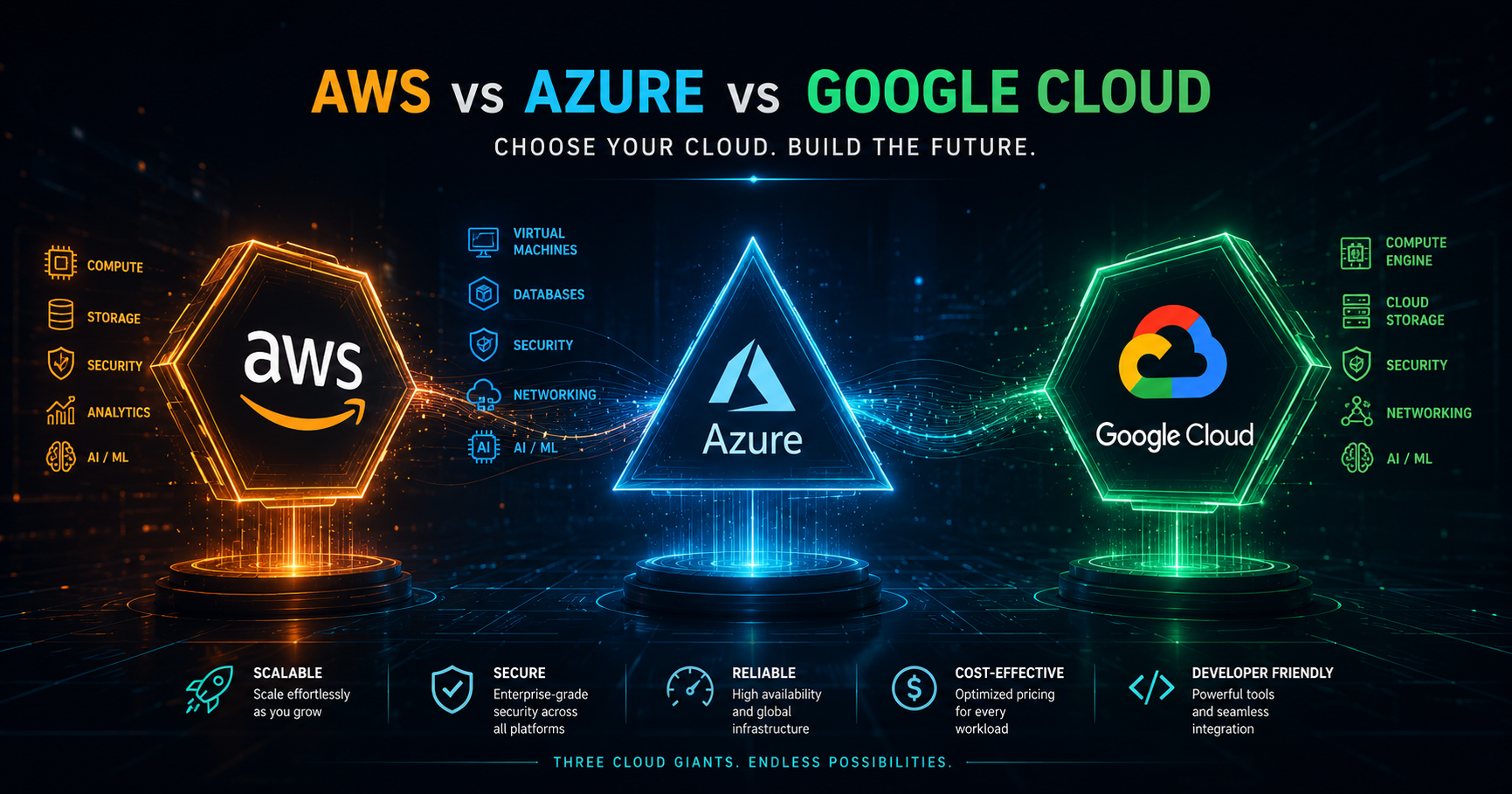
AWS, Azure or GCP. Which Cloud Should You Actually Learn?
When you are starting out in cloud computing everyone has an opinion. Learn AWS. It is the industry standard. Azure is better if you want enterprise jobs. GCP is where the real engineering happens. The problem is that most of this advice comes from people who learned one cloud got good at it and now swear by it. It is survivor bias dressed up as expertise.
So let us skip the opinions and look at the data. Job market numbers, honest trade-offs and a clear framework to help you decide based on where you want to go.
The Job Market Reality in 2026
Before diving into features let us talk about jobs. Because that is why most people are learning this stuff.
AWS dominates the job market. 60–65% Of cloud job postings mention AWS. From early-stage startups to mid-size tech companies to enterprises AWS is the default cloud platform that most companies use. Nothing else is close.
Azure is strong in enterprise. Banks, government agencies, large healthcare companies, traditional enterprises. These organizations are heavily Microsoft-integrated. They tend to stay that way. Azure accounts for around 25–30% of job postings and the roles tend to be stable and well-paying.
GCP is territory. Google Cloud shows up in 10–15% of job postings. The roles that do require tend to lean toward data engineering, machine learning and technically sophisticated companies. Fewer jobs,. Often interesting ones.
What this means for you:
- Want the options and the fastest path to employment? → Start with AWS cloud platform.
- Already working in a Microsoft- company or targeting enterprise? → Azure cloud platform makes sense.
- Interested in data engineering, machine learning or companies like Spotify and Twitter? → GCP cloud platform is worth the investment.
The Honest Take on Each Cloud
AWS. The Industry Default
AWS cloud platform has been around since 2006 and it shows. In the way. The mature services, the biggest community, the most Stack Overflow answers. When you hit a problem at 2am someone has certainly hit it before you.
The good thing about AWS cloud platform is that it has over 200 services. The recognized certification path is also available for AWS cloud platform. The largest job market by a margin is also for AWS cloud platform.
The not-good thing about AWS cloud platform is that the console is notoriously messy. 20 Years of incremental building will do that. IAM (Identity and Access Management) is powerful but genuinely complex and getting it wrong is a real security risk. The pricing has hundreds of dimensions. It is easy to rack up a surprise bill. Set billing alerts before you do anything on AWS cloud platform.
For: Startups, tech companies, SaaS businesses and anyone who wants maximum job options on AWS cloud platform.
Azure. Where Enterprise Lives
Azure cloud platforms greatest strength is its integration with Microsofts existing ecosystem. If your company runs Active Directory, Windows Server, SQL Server or Microsoft 365. Azure cloud platform just fits in a way the other clouds do not.
The good thing about Azure cloud platform is that it has enterprise adoption, stable well-paying roles and the best hybrid cloud story in the industry. Azure DevOps is widely used in environments and deeply integrated with the Azure cloud platform.
The not-good thing about Azure cloud platform is that documentation quality is inconsistent (improving, but still patchy in places). Linux support has gotten better. Still sometimes feels like it was bolted on. The community outside of enterprise is fewer tutorials, fewer blog posts.
Best for: Enterprise companies, financial services, healthcare, government and anyone working in Microsoft-integrated environments on Azure cloud platform.
GCP. The Underdog Worth Knowing
GCP cloud platform runs on the infrastructure that powers Google Search and YouTube. The networking performance and reliability are genuinely world-class.
The good thing about cloud platform is that Kubernetes was invented at Google. GKE is widely considered the best managed Kubernetes service. BigQuery is borderline magical for data work; it can query petabytes in seconds. The console is clean and well-organized and pricing is more straightforward than AWS cloud platform (sustained use discounts apply automatically).
The not-good thing about GCP cloud platform is that the job market is simply smaller. This is not a quality issue, just market reality.. Googles reputation for killing products makes some engineers hesitant to bet their infrastructure on it (GCP has been more committed than most Google products but the reputation lingers).
Best for: Data engineering, machine learning infrastructure Kubernetes- workloads and technically sophisticated companies on GCP cloud platform.
Services That Are Cross-Platform: Core Services Complete the Picture as Side by Side Services
Clouds can share similar functional services. This includes understanding how load balancers perform between AWS Cloud and plus size on GCP Cloud and Azure Cloud. While clouds have different product names applied to them, they serve the same functions.
Compute: AWS EC2, Azure Virtual Machines, or Google Cloud's Compute Engine
Managed Kubernetes: AWS EKS, Azure AKS, or Google Cloud EKS (being rated best amongst other cloud-based solutions)
Object Storage: AWS S3, Azure Blob Storage, or Google Cloud Storage
Managed DB: AWS RDS, Azure SQL Database, or Google Cloud SQL database
Serverless Functions: AWS Lambda, Azure Functions, or Google Cloud Functions
DNS: AWS Route53, Azure DNS, or Google Cloud DNS
Container Registry: AWS ECR, Azure Container Registry, or Google Cloud Artifact Registry
Monitoring: AWS CloudWatch, Azure Monitor, or Google Cloud Monitoring
The Certification Question
People always ask which certification is worth getting. Here is the honest answer:
AWS Certified Solutions Architect. Associate is the most recognized cloud certification in the job market. If you are going to get one certification get this one. Not a debate.
Microsoft Azure Administrator (AZ-104) is highly valued if you are targeting enterprise roles. Azure certifications carry weight in corporate hiring.
Google Cloud Professional Cloud Architect is. Has a smaller audience of hiring managers who specifically look for it.
CKA (Certified Kubernetes Administrator) is cloud-agnostic and highly valued across all three platforms. If you are going deep on Kubernetes this certification is worth more than any cloud certification.
One important caveat: certifications doors but do not get you hired on their own. A GitHub repository with Terraform code a Kubernetes cluster you have deployed a CI/CD pipeline you have built. These matter more than a certification by itself.
What Most Guides Will Not Tell You
The cloud you learn matters less than how deeply you learn it.
A DevOps engineer who genuinely understands networking, security and infrastructure principles can move between AWS cloud platform, Azure cloud platform and GCP cloud platform in a weeks. The services have names and quirks but the underlying concepts are universal.
What you can not easily transfer is knowledge. If you have clicked around the AWS cloud platform console without understanding what you are doing switching to Azure cloud platform will not fix that. You will just be confused in an interface.
Go on one cloud first. Understand the networking model. Understand IAM and permissions. Understand how managed services abstract infrastructure. Understand the billing model.
Once you have that foundation on one platform the others become much easier to pick up.
The Decision Framework
Learn AWS cloud platform if:
- You want job options
- You are going into startups, tech companies or SaaS
- You do not have a strong preference yet
- You want the largest community and most learning resources
Learn Azure cloud platform if:
- You already work at a company using Microsoft products
- You want to target enterprise, financial services or government roles
- You are interested in hybrid cloud scenarios
Learn GCP cloud platform if:
- You are interested in data engineering or machine learning infrastructure
- You want to work at data-heavy or technically sophisticated companies
- You already know AWS cloud platform and want to add a second cloud
Learn Kubernetes first if:
- You are going deep on container orchestration
- You want skills that are cloud-agnostic
- You are targeting Platform Engineer or SRE roles
Our Recommendation
If you are reading this without a strong opinion. Start with AWS cloud platform.
Not because it is the "cloud. Not because the others are not worth learning.. Because it gives you the most options, the largest community, the most learning resources and the most job postings.
Get comfortable, with the core services: EC2, VPC, S3, RDS, IAM, EKS and CloudWatch. Get the Solutions Architect Associate certification. Build some things with Terraform.
Then once you are working look at what your company uses. If clients want Azure cloud platform knowledge add it. If data projects need cloud platform learn it. The goal is not to know everything. It is to get good enough at one platform to start your career then keep building from there.